Hexa vs Septa Numbers: How Many Repeating Digits Is Too Many?
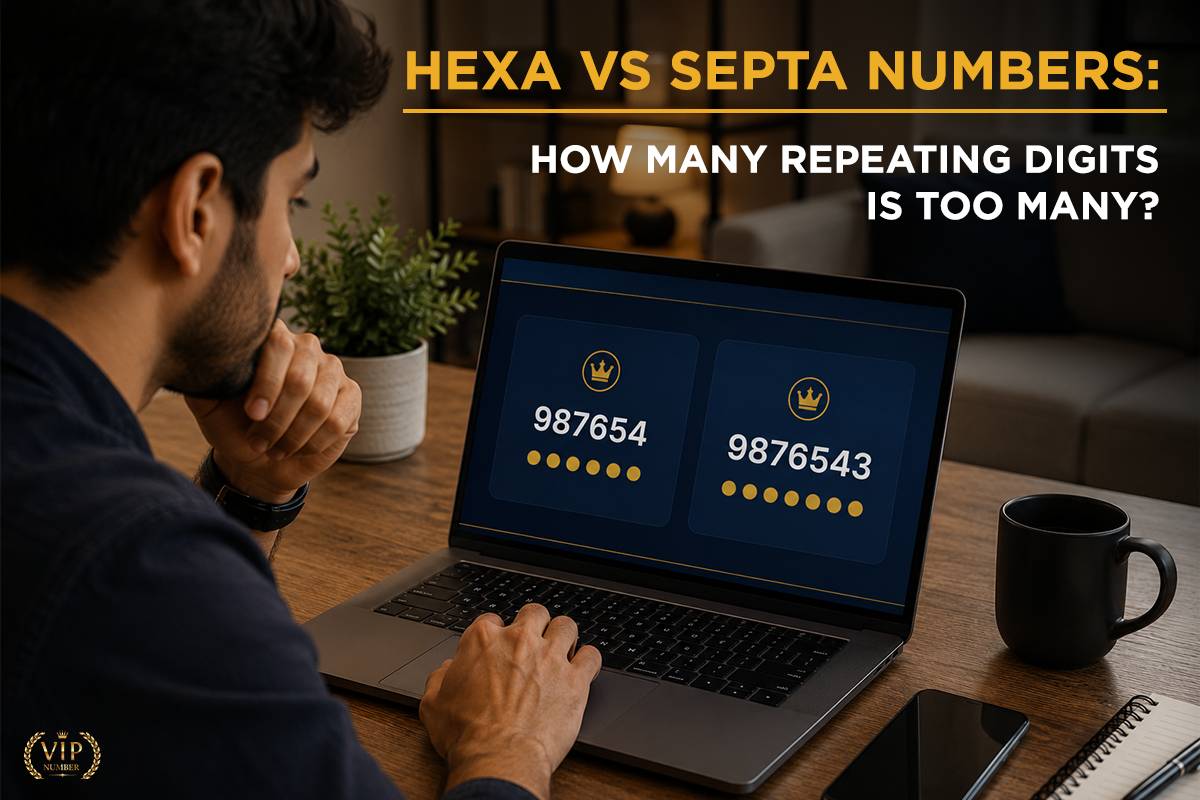
Hexa vs Septa Numbers: How Many Repeating Digits Is Too Many?
When it comes to choosing a VIP or fancy mobile number, repeating digits are one of the most popular patterns. Numbers with repeated digits are easy to remember, visually attractive, and often considered premium in the mobile number market.
Among the most interesting patterns are Hexa Numbers and Septa Numbers. But what exactly do these terms mean, and is there a point where having too many repeating digits becomes less desirable?
Let’s understand the difference.
What Are Hexa Numbers?
A Hexa number generally refers to a mobile number pattern containing six repeated instances of the same digit.
For example:
-
9877777721
-
9166666643
-
8899999912
The repeated digit may appear consecutively or, depending on the classification used by a VIP-number platform, may be distributed across the number.
Hexa patterns are considered attractive because six identical digits create a strong visual pattern while still leaving enough variation in the remaining digits.
What Are Septa Numbers?
A Septa number typically contains seven repeated instances of the same digit.
Examples include:
-
9877777777
-
916666666
-
889999999
Because seven identical digits occupy a large portion of a standard 10-digit Indian mobile number, Septa patterns are much more visually dominant than Hexa patterns.
This makes them particularly noticeable among VIP, fancy and premium mobile numbers.
Hexa vs Septa: What's the Difference?
The primary difference is simply the number of repeated digits.
|
Feature |
Hexa Number |
Septa Number |
|---|---|---|
|
Repeating digits |
6 |
7 |
|
Memorability |
Very High |
Extremely High |
|
Visual pattern |
Strong |
Very Strong |
|
Availability |
Relatively higher |
More limited |
|
Premium appeal |
High |
Very High |
|
Ease of recognition |
Excellent |
Exceptional |
|
Rarity |
Higher than normal patterns |
Generally rarer |
A Hexa number provides a strong repeating pattern without dominating the entire number. A Septa number takes the repetition one step further.
How Many Repeating Digits Is Too Many?
There is no universal rule saying that a particular number of repetitions is "too many."
However, from a number-design and memorability perspective, repetition should remain balanced.
3–4 Repeating Digits
Numbers with three or four repeated digits can be attractive and relatively easy to obtain.
Example:
98-7777-3210
These numbers provide a noticeable pattern without making repetition the main feature.
5–6 Repeating Digits
This is where numbers start looking distinctly premium.
Example:
98-777777-21
Six repeated digits can provide an excellent combination of:
Rarity + Memorability + Visual Appeal
This is one reason Hexa patterns are popular among VIP-number buyers.
7 Repeating Digits
A Septa pattern is even more distinctive.
Example:
98-7777777-1
With seven identical digits, the number becomes extremely easy to recognize.
However, the more digits that repeat, the less room there is for creating other interesting patterns.
8–9 Repeating Digits
Numbers containing eight or nine instances of the same digit are extremely unusual.
While such numbers may look impressive, they aren't automatically "better." At this stage, the number's appeal depends heavily on:
-
How the digits are positioned
-
The starting digits
-
The ending digits
-
Overall symmetry
-
Availability
-
Buyer preference
-
Numerology preferences, if applicable
In other words, more repetition does not necessarily mean more value.
Is a Septa Number Better Than a Hexa Number?
Not necessarily.
A Septa number may be rarer and more visually striking, but a Hexa number can sometimes be more balanced.
Consider these examples:
Hexa:
98-777777-21
Septa:
98-7777777-1
The Septa number has more repetition, but the Hexa number has a more balanced structure.
For some buyers, the Hexa number may actually look better.
Therefore, when selecting a VIP number, don't judge the number solely by how many digits repeat.
Hexa or Septa: Which One Should You Choose?
The answer depends on what you want.
Choose a Hexa Number if you want:
-
A premium-looking number
-
Strong repetition
-
Good balance
-
Easy memorability
-
More options to choose from
Choose a Septa Number if you want:
-
Maximum repetition
-
A highly distinctive number
-
A rare-looking pattern
-
Strong visual impact
-
Something that immediately stands out
If your priority is balance, Hexa may be the better choice.
If your priority is maximum repetition and rarity, Septa may be more attractive.
Final Thoughts
Hexa and Septa numbers are both excellent choices for people looking for memorable and premium mobile numbers.
A Hexa number uses six repeating digits, while a Septa number uses seven repeating digits. Septa numbers generally create a stronger visual impression, but that doesn't automatically make them better.
The ideal VIP number is the one that combines memorability, visual appeal, rarity and personal preference.
So, how many repeating digits are too many?
There isn't a fixed limit. Once repetition starts making the number less balanced or less attractive to you, you've probably gone far enough.
After all, the best premium number isn't necessarily the one with the most repeating digits—it's the one you can remember instantly and feel confident sharing.